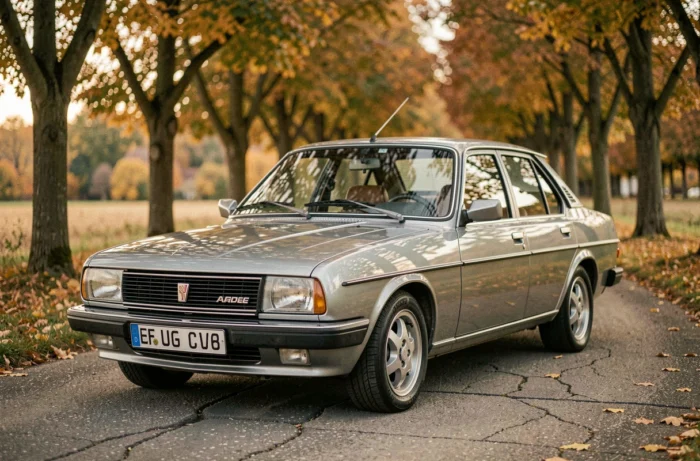
The Renault 30 never received a V8 under the hood. This detail may come as a surprise, but it conditions everything that can be said about this model: the engine that powers it is a V6 PRV directly derived from an abandoned V8 project from the early 1970s. Understanding this lineage is key to grasping both the qualities and the technical limitations of a sedan that attempted to elevate Renault to the level of German luxury cars between 1975 and 1983.
The V6 PRV of the Renault 30: a V8 with two cylinders amputated
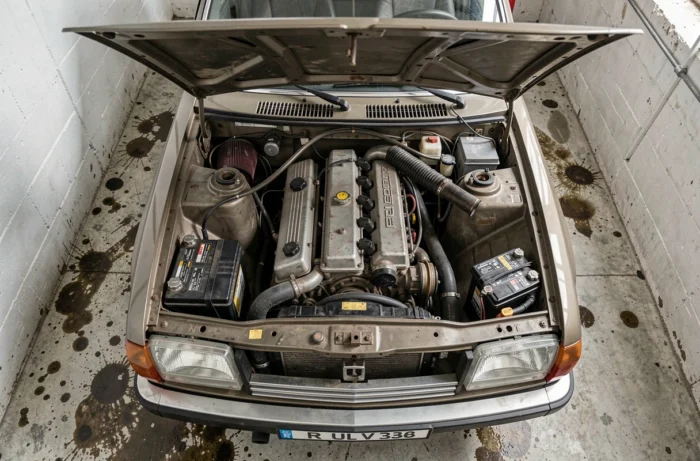
When you open the hood of a Renault 30 TS or TX, you find a V6 with a 90° angle. This detail is not trivial. A classic V6 adopts a 60° angle for reasons of natural balance. The 90° angle betrays the origin of the block: it was designed as a V8.
In the early 1970s, Peugeot, Renault, and Volvo teamed up to develop a common high-end engine, the famous PRV. The initial specifications aimed for a V8. The oil crisis of 1973 changed everything. Rather than starting from scratch, the engineers removed two cylinders from the V8 while retaining the 90° block, which allowed them to save time and reduce development costs.
This choice has direct consequences on the engine’s behavior. The angle inherited from the V8 generates an intrinsic imbalance in a six-cylinder engine, leading to vibrations that the engineers had to compensate for with a balancing shaft. You can learn everything about the Renault 30 V8 by consulting the technical sheets of the time, but it is important to remember that the designation “V8” refers to this mechanical lineage, not to an actual eight-cylinder engine produced in series.
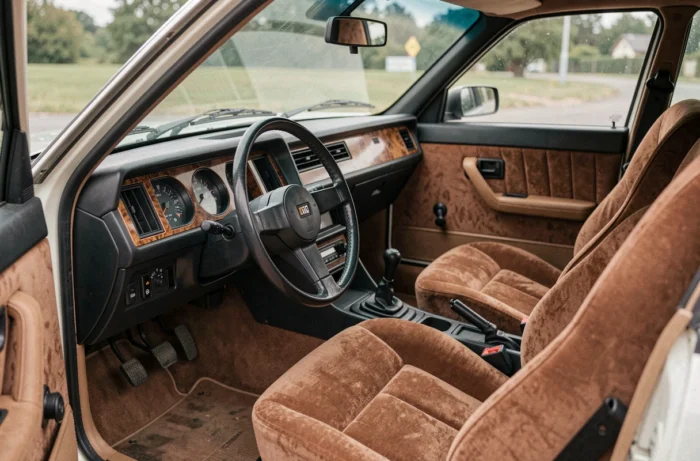
Technical specifications of the PRV engine: practical characteristics for maintenance
On the ground, what matters to an owner or potential buyer is knowing what to expect mechanically. The V6 PRV of the Renault 30 comes in two main configurations depending on the model year and versions (TS then TX).
Architecture and fuel supply
The block is made of aluminum, which makes it relatively light for the time. The fuel supply is via a carburetor on the early TS versions, then through injection on the TX starting from 1978-1979. This switch to injection improves power and flexibility but complicates maintenance for those without the appropriate tools.
- 90° aluminum V6 block, displacement close to 2.7 liters, driven by overhead camshaft
- Five-speed manual or three-speed automatic transmission depending on the versions, with the gearboxes shared between the TS and TX
- Fuel supply via carburetor (first generation TS) or Bosch K-Jetronic mechanical injection (TX), the latter being significantly more sought after today
- Liquid cooling with a system that requires regular monitoring, as head gasket leaks are a known weak point of the PRV
Maintenance points for the V6 PRV
Head gaskets are the Achilles’ heel of the PRV engine. The aluminum block and lightweight alloy cylinder heads do not handle overheating well. A neglected cooling system can cause warping of the cylinder head, a costly repair on a vehicle whose parts are becoming scarce.
The chain-driven timing theoretically offers greater longevity than a belt, but the chain tensioners wear out, and their replacement requires removing part of the front of the engine. Feedback varies on this point depending on the overall condition of the vehicle and its maintenance history.
Renault 30 TS vs TX: what really changes from one version to another
The two main versions of the Renault 30 differ not only in engine fuel supply. The TX, introduced at the 1978 Paris Motor Show, marks a significant upgrade.
In terms of equipment, the TX receives aluminum wheels, tinted windows, and a revised interior with more refined materials. The chrome central pillar (B-pillar) becomes a distinctive visual sign. The injection improves throttle response and reduces fuel consumption compared to the carburetor, although the V6 PRV remains thirsty compared to the four-cylinder engines of the time.
The original TS, marketed as early as March 1975, underwent several model year evolutions: changes to engine fuel supply starting in 1977 (with a slight decrease in power), followed by gradual improvements to the dashboard and safety equipment. For a collector, the 1977-1978 model year of the TS is the most challenging to evaluate as it combines transitional modifications without benefiting from the enhancements of the TX.
Youngtimer value and current market for the Renault 30
The Renault 30 is one of those models that have long been overlooked by collectors, but are starting to attract attention in the youngtimer segment. Produced in just over 136,000 units over eight years, it was never a massive commercial success, which today limits the number of vehicles available in good condition.
The French youngtimer market is experiencing a general resurgence of interest. Models that no one wanted just a few years ago are now finding buyers among collectors who appreciate their rarity and technical history. The Renault 30 TX with injection benefits from this trend, its PRV mechanics being shared with more prestigious models like certain Volvos and the DeLorean DMC-12.
For purchasing, one should prioritize a specimen whose cooling system has been recently overhauled and whose maintenance documentation is complete. A well-maintained PRV still runs smoothly, but a neglected engine can lead to costly surprises on a vehicle whose specific parts are no longer available at dealerships.
The Renault 30 remains a case study in French automotive history: an ambitious sedan powered by an engine born from an industrial compromise between three manufacturers and a global energy crisis. Its 90° V6 tells the story of why the French luxury segment of the 1970s did not follow the same path as its German competitors.