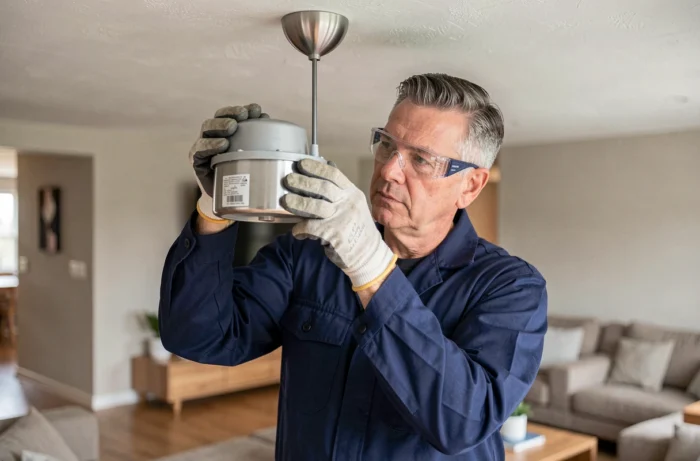
Class 2 and protection 2 refer to two distinct technical realities, but confusion between the two persists on most product sheets. The first refers to a standardized electrical protection class (class II, as defined by the NF EN 61140 standard). The second corresponds to a power limitation on the luminaire’s power supply circuit (class 2, related to LED drivers).
This article measures the concrete differences between these two concepts to guide the choice of a luminaire suitable for each room.
Class II and class 2: comparative table of technical characteristics
| Criterion | Class II (electrical protection) | Class 2 (limited power circuit) |
|---|---|---|
| Reference standard | NF EN 61140 | Standards related to LED drivers and power supplies |
| Object | Protection of people against electric shocks | Limitation of the energy delivered by the driver |
| Principle | Double insulation or reinforced insulation, no grounding | Limited output voltage and current to reduce fire risk |
| Symbol | Double square (square within a square) | Label “class 2” on the driver or power supply |
| Typical supply voltage | 230 V (mains) | Low voltage at driver output (often 12 V or 24 V) |
| Grounding connection | Not required | Not applicable (concerns the secondary circuit) |
This table highlights that class II protects against electric shock, class 2 limits the energy of the circuit. A luminaire can combine both or present only one. A comprehensive article on the differences between class 2 luminaires and protection 2 also details the intersection with IP ratings.
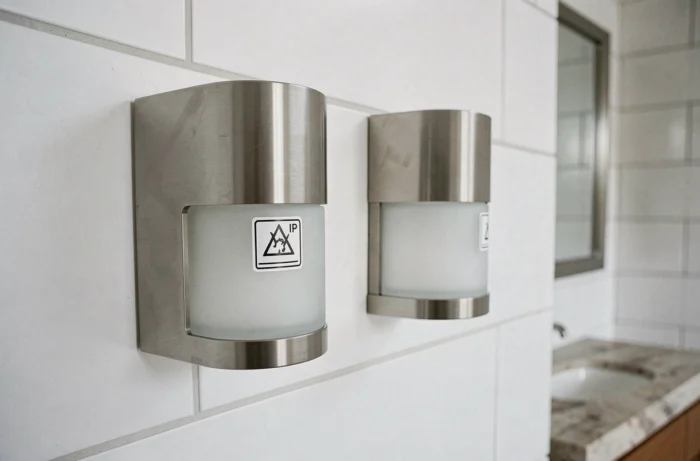
Double insulation class II: what the NF EN 61140 standard requires of the luminaire
A class II luminaire relies on double insulation or reinforced insulation between live parts and accessible surfaces. No earth conductor is connected: safety does not depend on the installation’s protection circuit.
In practice, this means that the housing, connection terminals, and internal wiring are designed so that a single insulation fault can never make a touchable surface live. The double square symbol, printed on the luminaire’s label, certifies this compliance.
Class II and 30 mA differential: two complementary protections
The NF C 15-100 series in its 2024 version requires a 30 mA differential device on all lighting circuits, including those supplying class II luminaires. Therefore, double insulation does not exempt from this upstream protection.
This layering of barriers (reinforced insulation at the luminaire level, differential at the panel level) forms the safety foundation for dry rooms as well as for bathroom volumes.
Class 2 LED driver: power limitation and role in the installation
The mention “class 2” on an LED driver indicates that its output is limited in voltage and current, in order to contain the available energy in case of a fault. This approach primarily aims at preventing fire risk on the secondary circuit (LED side).
A class 2 driver delivers low voltage, often 12 V or 24 V, with a capped current. The luminaire powered by this driver can operate safely even if the secondary wiring experiences a short circuit, as the released energy remains insufficient to cause dangerous heating.
Remote driver outside the volume: a compliance point often overlooked
In bathrooms, class 2 LED drivers are often located outside the volumes defined by the NF C 15-100. The luminaire itself, installed in volume 2 for example, can be class II with an appropriate IP rating. However, the driver, powered at 230 V on the primary side, must be positioned in a space where volume constraints do not apply.
The class 2 driver does not replace the class II of the luminaire, and vice versa. The two concepts operate on different segments of the electrical chain.
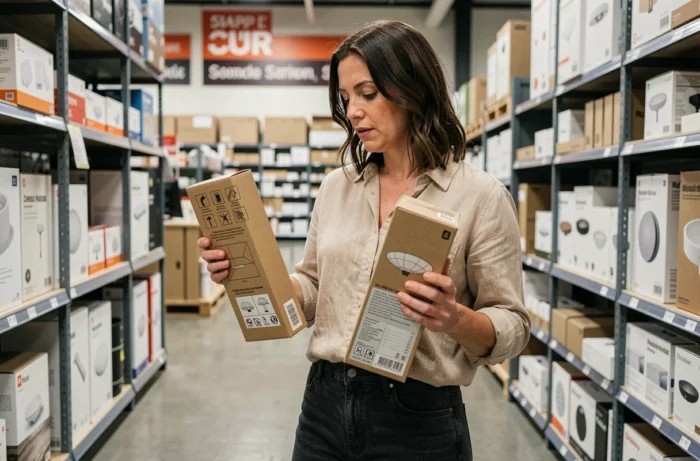
Luminaire in the bathroom: class II, IP rating, and class 2, how they combine
The bathroom has the strictest requirements. The NF C 15-100 divides the space into volumes (0, 1, 2, and outside volume), each imposing specific constraints on the protection class and IP rating of the luminaire.
- Volume 0 (inside the bathtub or shower tray): only very low voltage safety luminaires (TBTS, class III) are allowed, with a high IP rating.
- Volume 1 (above the bathtub or shower tray, up to a certain height): TBTS mandatory, IP suitable for water splashes.
- Volume 2 (peripheral zone): a luminaire of class II with a minimum IP rating of IPX4 is generally required. The class 2 driver is then located outside the volume.
- Outside volume: constraints are relaxed, but the 30 mA differential remains mandatory on the circuit.
This hierarchy shows that class II at 230 V remains reserved for volume 2, while TBTS (class III) covers the areas most exposed to water. The class 2 driver, in turn, acts as an additional layer of safety on the secondary circuit, regardless of the volume where the luminaire is located.
Selection criteria: protection class and type of driver according to the room
For dry rooms (bedroom, living room, hallway), a class II luminaire without a class 2 driver is sufficient in most cases. Double insulation ensures safety, and the 30 mA differential from the panel complements the system.
For wet rooms, the combination of class II, appropriate IP rating, and remote class 2 driver offers the most robust level of compliance. Checking the luminaire label (double square symbol) and the driver label (class 2 mention) remains the only reliable way to ensure that both protections are present.
- Luminaire label: double square symbol = class II, IP rating (e.g., IP44) = protection against water and solid bodies.
- Driver label: mention “class 2” = energy limitation at output.
- Electrical panel: 30 mA differential on the lighting circuit, mandatory in all cases since the NF C 15-100 version 2024.
The confusion between these two concepts sometimes leads to installing a class 2 luminaire (in terms of the driver) thinking it is class II (in terms of electrical protection). Reading both labels, luminaire and driver, remains the only reliable check before any installation.