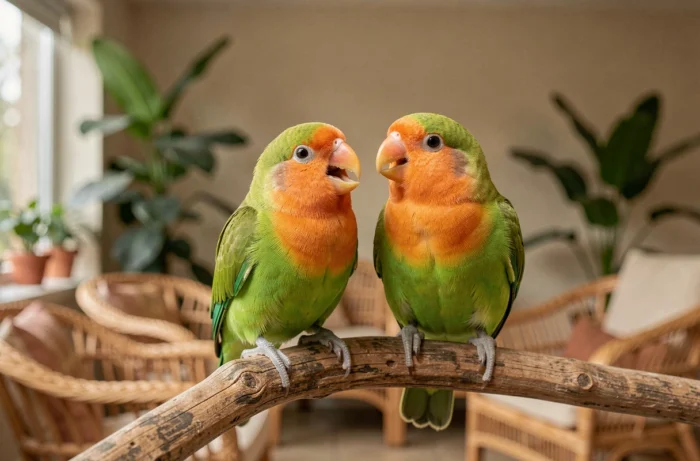
Lovebirds vocalize several times a day, with marked peaks at sunrise and sunset. Understanding the song of lovebirds first involves distinguishing between normal communication and signals of distress. The volume of these small psittacines often surprises novice owners, but not all vocalizations are equal, whether in frequency, intensity, or cause.
Decoding the Types of Calls in Lovebirds
Before trying to reduce the noise, it is essential to understand what the bird is expressing. Each type of vocalization corresponds to a specific function, and the appropriate response varies significantly from case to case.
| Type of Vocalization | Usual Time | Probable Cause | Appropriate Reaction |
|---|---|---|---|
| Soft and melodic chirps | Daytime, resting | Well-being, vocal exploration | No intervention |
| Short and repeated cries | Morning, late afternoon | Contact call (locating the group) | Respond briefly with your voice |
| Continuous and high-pitched screams | Variable | Boredom, loneliness, under-stimulation | Review enrichment |
| Sudden shrill cries | Unpredictable | Fear, perceived threat | Identify and remove the stress factor |
| Nocturnal vocalizations | Night | Light disturbance, ambient noise | Cover the cage, isolate from light sources |
Chirps and contact calls are part of the normal repertoire. A silent lovebird is more concerning than a noisy one. Prolonged absence of vocalization may indicate illness or a depressive state.
Continuous screaming, on the other hand, is the main alert signal. When the bird screams uninterrupted for long periods, it is almost always an indicator of environmental distress.
Understanding the song of lovebirds allows for appropriate reactions rather than punishing a behavior that, most of the time, simply requires an adjustment in their living conditions.
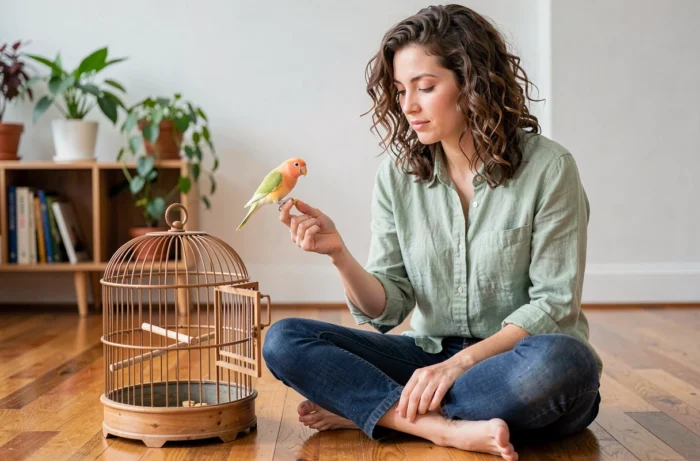
Under-stimulation and Poor Environment: The Primary Cause of Excessive Screaming
Recent guides on lovebird enrichment explicitly link prolonged screaming, pacing (nervous back-and-forth on the perch), and feather plucking to an insufficiently stimulating environment. A bored bird screams to compensate for the lack of activity.
A lovebird in a standard cage, with two perches and a feeder, lacks everything that occupies a psittacine in the wild: foraging, exploration, varied social interactions. The result is predictable: frustration vocalizations that become a daily reflex.
Food and Cognitive Enrichment
Foraging is the most documented strategy for reducing boredom-related screams. Hiding seeds in crumpled paper, using foraging toys, or scattering food in different parts of the cage forces the bird to work for its meals.
- Rotating toys (replaced weekly) maintain curiosity and reduce habituation, a major factor in disinterest
- Short sessions of positive reinforcement (rewarding calm behavior with a treat) create a lasting association between silence and gratification
- Untreated natural branches, coconut fibers, and shreddable materials provide motor occupation that channels vocal energy
An occupied lovebird vocalizes less problematically than a bird left in a stimulation-poor cage. The difference is often noticeable within a few days after introducing new elements.
Lovebird Alone or in Pairs: What Changes with the Presence of a Companion
The question of companionship consistently arises in forums. Adding a second lovebird seems logical for a bird whose very name evokes a pair bond. The reality is more nuanced.
A pair reduces certain stressors, notably the contact call directed towards the absent human. The two birds interact with each other, preen one another, and share soft vocalizations. The presence of a companion decreases loneliness cries but does not eliminate boredom cries.
Recent field reports emphasize that a pair does not replace cage enrichment, supervised out-of-cage time, or daily interaction with humans. Two lovebirds in a poor environment will produce double the noise, not half.
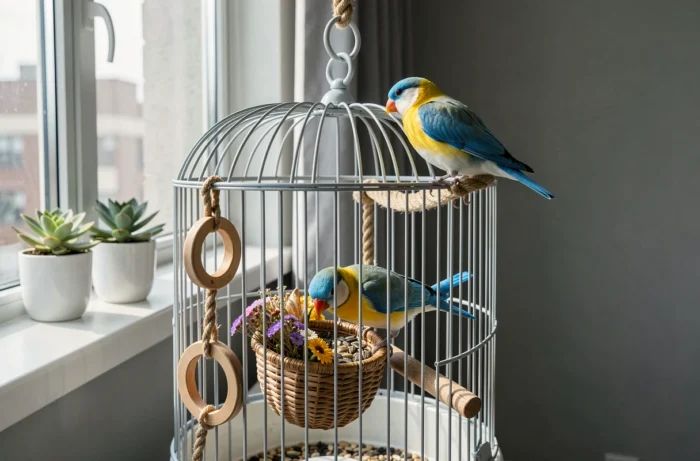
Precautions Before Introducing a Second Bird
Improperly managed introduction of a companion generates additional stress. A veterinary quarantine is recommended, followed by a period of separate but close cages. Forcing cohabitation in a cage that is too small produces the opposite effect of what is desired: aggression, panic screams, and heightened territoriality.
Light Rhythm and Daily Routine of Lovebirds
Lovebirds are particularly sensitive to the day-night cycle. Peaks of vocalization at dawn and dusk are normal and should not be suppressed. These are ancestral contact calls related to the gathering of the group before nightfall.
A regular light cycle of ten to twelve hours of darkness reduces vocal excitement. Covering the cage in the evening at a fixed time with an opaque cloth, and uncovering it in the morning according to a consistent schedule, stabilizes the bird’s circadian rhythm.
The most frequent disturbances are screens left on late at night, artificial lights in the room with the cage, and sudden nighttime noises. A lovebird awakened in the middle of the night by a light source may start screaming out of panic, establishing a cycle of cumulative stress.
- Place the cage in a room where lighting is controlled after the bird’s bedtime
- Avoid sudden changes in brightness (sudden lighting, TV flashes)
- Maintain a stable temperature in the resting area, as thermal fluctuations amplify nervousness
What Not to Do in Response to Screaming
Yelling back, shaking the cage, or covering the cage during the day as punishment are counterproductive reactions. The bird interprets the human’s vocal reaction as a response to its call, reinforcing the behavior. Ignoring excessive screams while rewarding calm moments remains the most effective method in the medium term.
Withdrawing food or isolating the bird in a dark room during the day constitutes abuse and systematically worsens the problem. A lovebird stressed by punishment will vocalize more, not less.
The majority of chronic screaming situations can be resolved through a combination of food enrichment, stabilization of the light rhythm, and daily positive interactions. When these three parameters are in place, vocalizations gradually return to their normal level, that of a sociable little parrot communicating with its environment.