
Organizing a trip relies on a chain of interdependent decisions: the choice of destination conditions the budget, which in turn determines the mode of transport and accommodation. Mastering this chain transforms a list of scattered tasks into a coherent plan, tailored to one’s real constraints.
New administrative formalities before departure
Before thinking about the itinerary or suitcase, the first step concerns the documents required for entry into the target country. Formalities evolve quickly, and a mistake at this stage can block boarding.
Since April 2, 2025, nationals of the European Economic Area and Switzerland must obtain an electronic travel authorization (ETA) online to enter the United Kingdom. This authorization is fee-based and is not issued at airport or train station counters: without it, boarding is denied.
For travel within the European Union, new biometric rules (fingerprints, photo) are gradually being implemented at borders. Checking the requirements of the destination country several weeks before departure avoids unpleasant surprises, especially for stays outside the Schengen area.
A useful reflex before booking anything: consulting Voyages 365 to organize your trip allows you to cross-reference information on formalities, transport, and available accommodations based on the chosen destination.
Travel budget: building a realistic envelope before booking
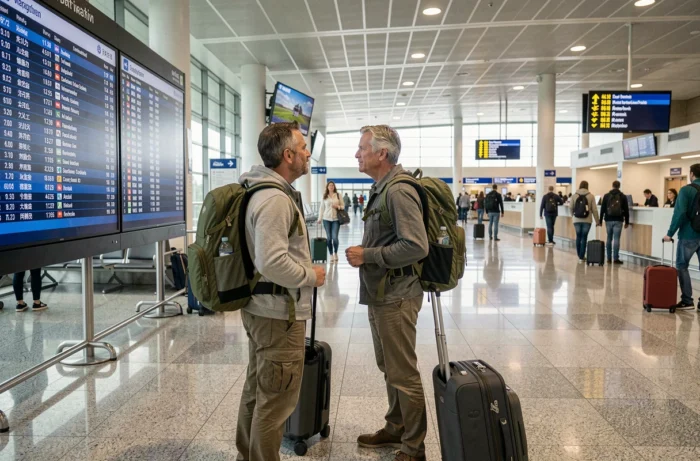
The budget is the foundation of any travel organization. Defining it too late exposes you to frustrating compromises, such as sacrificing an activity or changing accommodation mid-trip.
Breaking down the budget into fixed and variable items clarifies the trade-offs. Fixed items (round-trip transport, accommodation, insurance) are binding and should be booked first. Variable items (meals, activities, purchases on-site) provide the flexibility.
Two often-overlooked points deserve special attention:
- Foreign banking fees, which vary depending on the card and the currency of the target country. Some online banks offer commission-free withdrawals, while others charge a percentage on each payment.
- The actual cost of checked baggage on low-cost airlines, which can exceed the price of the ticket if the reservation is made last minute at the counter.
- Travel insurance, sometimes already included with the credit card, but whose coverage limits are often insufficient for a long stay or a distant destination.
Booking transport and accommodation separately provides more flexibility to adjust each item. All-inclusive packages are suitable for standard beach stays but limit the negotiation margin on each component.
Air passenger rights: what changes with the European reform
The European Union adopted in July 2026 the first major overhaul in over twenty years of the Regulation 261/2004 on air passenger rights. The new rights will only come into effect in 2027, but knowing them now allows for better airline choices.
Among the notable changes: refund procedures will be expedited, tariff transparency will be enhanced, and airlines will have to offer new rerouting obligations in case of canceled or significantly delayed flights.
The reform also requires that airlines and booking platforms display a fare including a carry-on bag from the start of the booking process. Specifically, the right to a free personal item in the cabin will be guaranteed, and the allowed dimensions must be clearly indicated before purchasing the ticket.
For travelers who book now for a stay planned after the implementation of these rules, checking the airline’s general conditions remains necessary. During the transition period, the old rights still apply.
Packing your suitcase: the layering method rather than by category

Most guides recommend sorting clothes by category (tops, bottoms, underwear). This approach works for wardrobes, not for suitcases.
Folding by layered stacks makes better use of the available volume. The principle: lay the clothes flat, alternating the direction (collar facing down, then collar facing up), leaving the ends sticking out. Once all the clothes are stacked, fold the ends towards the center. This technique minimizes wrinkles and compacts the contents.
For stays longer than a week, planning versatile clothing that can be worn in multiple contexts (walking day, dinner out) reduces the total volume. A pair of dark pants and a light shirt cover most situations.
One last often-ignored point: weigh your suitcase before heading to the airport. Overweight charges for checked baggage can be expensive, and bathroom scales provide a sufficient approximation.
Centralizing travel information in a single document
Scattering booking confirmations across three email accounts, an app, and screenshots makes each step of the journey slower. Consolidating all information into a single document accessible offline simplifies each transition (airport, check-in, car rental).
This document gathers reservation numbers, accommodation addresses, transport schedules, emergency contacts, and a digital copy of the passport. A simple PDF file stored on the phone and shared with a travel companion is sufficient.
The goal is not to plan every hour of the stay but to have all logistical data in one place. The time saved by not searching for a confirmation email in a queue can be reinvested in the trip itself.
The preparation for a trip ends when each booking is confirmed, each document is gathered, and each administrative constraint is lifted. The rest belongs to the stay.