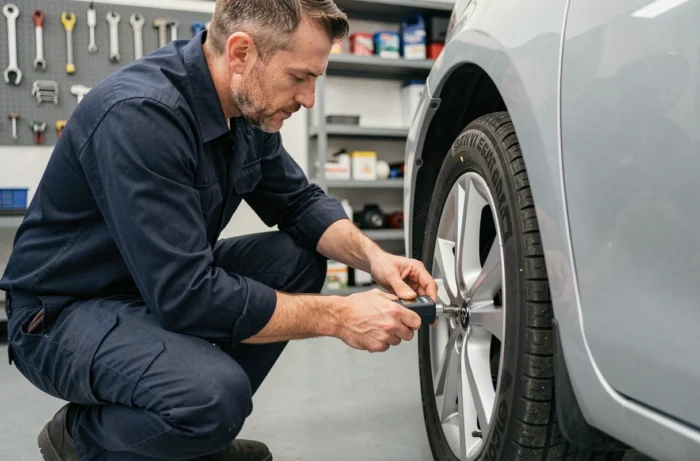
The Toyota Yaris hybrid displays pressure values that vary according to the tire size mounted, the load level, and the vehicle generation. A difference of a few tenths of a bar between the front and rear, or between normal load and full load, affects road behavior, consumption, and wear.
This article compares the recommended pressures by size, details the differences between normal load and full load, and then examines the operation of the TPMS system specific to the current Yaris hybrid.
Recommended pressures by tire size on Yaris hybrid
The values published by Toyota depend directly on the tire size. Here are the main sizes encountered on the Yaris hybrid (generation IV, since 2020), under normal load and maximum load.
| Size | Front (bar) | Rear (bar) | Front loaded (bar) | Rear loaded (bar) |
|---|---|---|---|---|
| 185/65 R15 | 2.3 | 2.2 | 2.5 | 2.4 |
| 195/50 R16 | 2.3 | 2.2 | 2.5 | 2.4 |
| 195/55 R16 | 2.2 | 2.0 | – | – |
| 205/45 R17 | 2.2 | 2.0 | – | – |
Two constants emerge: the front always receives a slightly higher pressure than the rear, due to the weight of the hybrid powertrain concentrated on the front axle. The difference is between 0.1 and 0.2 bar depending on the size.
Adjusting the tire pressure for Toyota Yaris hybrid to the actual load of the vehicle remains an uncommon reflex. The “loaded” columns of the table show an increase of 0.2 to 0.3 bar compared to normal values, which is not trivial on a compact vehicle.

Difference between normal load and full load: what the numbers convey
For the 185/65 R15 size, the front pressure increases from 2.3 bar under normal load to 2.5 bar under full load. The rear follows the same logic, from 2.2 to 2.4 bar. These two additional tenths compensate for the increased deformation of the tire sidewall when the trunk is full and four passengers occupy the cabin.
Not correcting the pressure in a maximum load situation leads to relative underinflation. The tire deforms more, the contact patch on the ground expands asymmetrically, and the internal temperature rises faster. On the highway, this combination accelerates shoulder wear and degrades directional stability.
The difference between front and rear under full load remains stable (0.1 bar on the 185/65 R15). Toyota does not change the inflation distribution; it simply raises the overall threshold. The driver loading their vehicle for a vacation departure should therefore inflate all four tires in one operation, without limiting themselves to the rear.
Yaris hybrid TPMS: direct sensor and limitations of the warning light
The Yaris IV hybrid uses a direct sensor TPMS system, housed in each wheel. Each sensor measures the pressure in real-time and transmits the information to the onboard computer. The warning light on the dashboard illuminates when the pressure drops below a threshold defined by the manufacturer.
A turned-off warning light does not guarantee that the tires are at the correct pressure. The TPMS functions as an alert device, not as a fine-tuning instrument. A tire inflated to 2.0 bar instead of 2.3 bar may remain under the radar of the sensor while being underinflated compared to Toyota’s recommendation.
Resetting the TPMS sensor after inflation
The reset procedure on the Yaris IV goes through the multifunction screen menu. On some older models, a physical button serves this function. The key point to remember is: the reset memorizes the current pressure as a new reference. Initiating this operation before correcting the inflation amounts to recording a faulty baseline, and the system will no longer detect the discrepancy.
The logical sequence is therefore:
- Inflate all four tires when cold, adhering to the manufacturer’s table values for the mounted size and expected load level
- Check each tire with a pressure gauge (a filling station or a portable gauge is sufficient)
- Initiate the TPMS reset from the vehicle menu once all pressures are confirmed
Cold measurement and pressure on the tire sidewall: two common pitfalls
Pressure naturally increases after a few kilometers of driving. Never deflate a hot tire to return to the “cold” value: the Toyota manual explicitly advises against this. The reliable method is to wait for the tire to cool down, then check again.
The second pitfall concerns the maximum pressure mentioned on the tire sidewall. This number corresponds to the limit supported by the tire structure, not to the vehicle’s inflation recommendation. The value to apply depends on the mounted size and load, not the marking on the sidewall.
The reference label is located on the driver’s door pillar. It indicates the pressures in bar, kPa, and psi for each approved size. In case of doubt between two sources, this label takes precedence over any other reference.
- The manufacturer’s label on the door pillar remains the primary reference
- The owner’s manual details the values by size and load level
- The maximum pressure inscribed on the tire sidewall is not an inflation recommendation
A monthly check, with cold tires, adjusting the pressure according to the expected load, and resetting the TPMS in the correct order, covers most of what the Yaris hybrid requires. The differences between tire sizes are small, but ignoring them means allowing the vehicle to operate outside the parameters for which its chassis was calibrated.