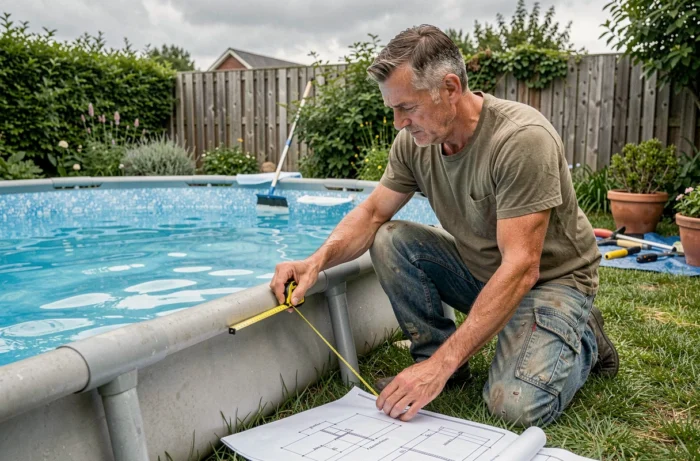
Your pool takes up too much space in the garden, or the inherited pool with the house far exceeds your needs. Reducing the size of an existing pool is a technical operation that raises concrete questions: should a new wall be poured, the liner modified, or the filtration adapted? This guide lays the groundwork for approaching this project without unpleasant surprises.
Local regulatory constraints before touching the pool
Before even thinking about the work, check what your municipality allows. Any modification to the surface of an in-ground pool may require a prior declaration of work, or even a building permit if the configuration of the land changes (backfill, retaining wall, slab).
In 2026, drought restrictions add an additional layer. In several departments, filling and leveling private pools are prohibited at the “crisis” level. The rules vary from one watershed to another. Consult VigiEau and the prefectural decree of your department before planning a drainage or filling related to reduction work.
A lesser-known point: some prefectural decrees explicitly exempt collected rainwater from the filling prohibition. If you have a rainwater collection tank, it is a concrete lever to supply a reduced pool without violating network restrictions.
Starting the reduction of the pool without checking these obligations exposes you to a fine and, in the worst case, the obligation to restore the pool to its original state.
Structural diagnosis of the existing pool: where to start
Have you already noticed cracks on the walls or tiles that are coming off? These signs guide the diagnosis. A reinforced concrete pool cannot be reduced in the same way as a fiberglass shell or a block structure.
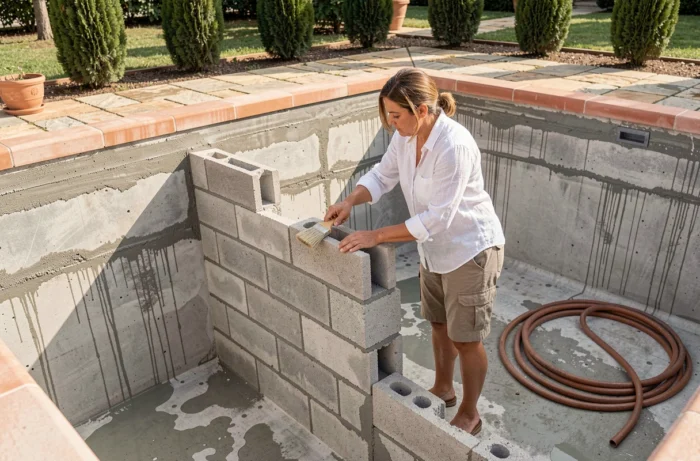
The structural diagnosis determines the choice of reduction method. A pool specialist or a specialized mason evaluates three elements:
- The condition of the slab (the bottom slab): if it has active cracks, pouring a separating wall on top is risky without underpinning.
- The thickness and reinforcement of the walls: a wall that is too thin or poorly reinforced will not withstand the pressure of the backfill on the sealed side.
- The location of the sealed parts (skimmer, return, bottom drain): if they fall within the area to be removed, they need to be repositioned on the retained pool side.
Why is this diagnosis a priority? Because the cost of the project varies greatly depending on the condition of the structure. On a healthy pool, building a separating wall with concrete blocks or poured concrete remains the most common operation. On a degraded pool, structural renovation can cost more than the reduction itself.
Concrete methods to reduce the size of an in-ground pool
Two approaches dominate, depending on the extent of the desired reduction.
Concrete separating wall
This is the most reliable technique for shortening a rectangular pool. A wall made of solid blocks or poured concrete is cast perpendicular to the existing walls, at the chosen location. The new wall must be bonded to the slab and the walls with connecting steel, otherwise, it risks detaching under water pressure.
The sealed part is then backfilled (gravel, general fill) or left empty if it serves as an underground technical room. A new liner or a sealing coating covers the inner face of the wall on the pool side.
Raising the bottom to reduce volume
Do you not want to shorten the pool but decrease its depth? A reinforced concrete slab poured over the existing bottom reduces the volume of water without changing the footprint. This method is particularly suitable for pools that are too deep for family use.
Reducing the depth decreases the volume of water and thus the consumption of treatment products. The filtration runs for a shorter time, and the pump consumes less. This is a direct maintenance gain.

Adapting filtration and the liner to the new volume
A smaller pool does not require the same pump power. If your current pump is sized for a large volume, it will be oversized after reduction. The result: unnecessary electricity consumption and a flow rate that may damage the liner.
Have a professional recalculate the filtration time. A reduced pool requires a shorter cycle. If your pump is recent, a variable speed drive may be sufficient to adjust the flow without changing the equipment.
Regarding the lining, the liner must be custom-made. The dimensions of the new pool are taken after the construction of the separating wall. Ordering the liner before the end of the major work is a common mistake: the final measurements are only reliable once the concrete is dry and the finishes are in place.
Also consider the solar heating system or heat pump if you have one. A reduced volume of water heats up faster, which may justify lowering the power or operating time of the device.
What the reduction changes for winterizing and regular maintenance
A smaller pool concretely changes your maintenance habits. The volume of water to be treated decreases, which reduces the amount of necessary products (chlorine, pH, algaecides).
For winterizing, the procedure remains the same, but with an advantage: less water means less risk of freezing in the pipes if you practice passive winterization. The ice plug exerts pressure proportional to the volume. A reduced pool experiences less mechanical stress in winter.
Cleaning the bottom also takes less time. A pool robot sized for a large pool will cover the surface more quickly, reducing wear on brushes and electricity consumption.
Reducing a pool is not a trivial project, but it is an investment that shows up every year on water, electricity, and maintenance product bills. The starting point always remains the same: a serious structural diagnosis and a check of local rules before the first blow of the hammer.