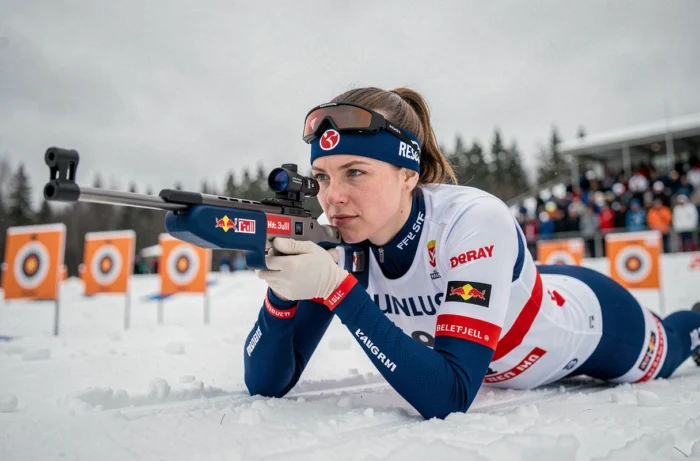
When following a stage of the World Cup in biathlon, the ranking displayed on the screen seems clear: the first to cross the line wins. The reality of the overall women’s ranking is based on a system of cumulative points earned race after race, with rules that vary depending on the format. Understanding this mechanism changes the interpretation of an entire season.
Shooting penalties and skiing times: what really creates a women’s biathlon ranking
All biathlon events share a foundation: the final ranking is based on the total time at the finish. Shooting does not award separate points, but each missed target costs seconds or additional distance.
In the sprint, a missed target sends the biathlete on a penalty loop. In the individual event (15 km for women), the format is stricter: each missed shot adds a minute to the final time. A fast athlete on skis but inaccurate in shooting can lose several places in just a few seconds.
For the pursuit, mass start, and relays, the principle remains that of a linear race: the first to cross the finish line wins, end of story. This explains why the women’s biathlon ranking and point allocation is never just about pure speed on skis.
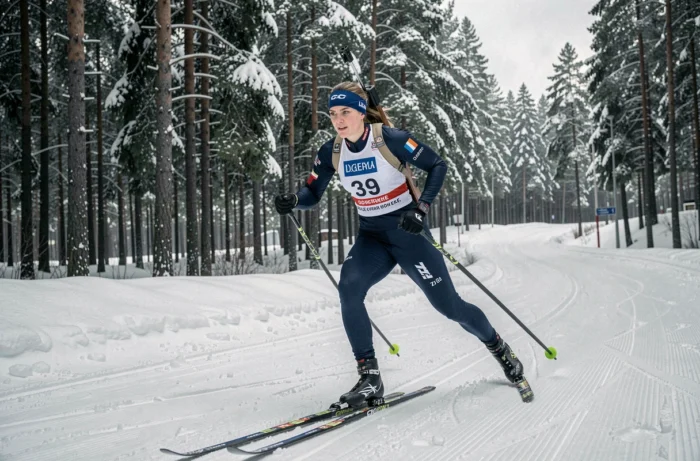
Point scale in the women’s World Cup: sprint, pursuit, mass start, and individual
Each World Cup race awards points to the top finishers. The winner of an individual event receives the maximum, and the allocation decreases by rank. This scale is identical for men and women.
The events considered in the overall ranking are the sprint, pursuit, mass start, and individual. Each contributes points to both the discipline ranking and the overall cumulative ranking. A table summarizes the logic:
| Format | Distance women | Shooting sessions | Consequence of a missed shot |
|---|---|---|---|
| Sprint | 7.5 km | 2 (prone + standing) | Penalty loop |
| Pursuit | 10 km | 4 (2 prone + 2 standing) | Penalty loop |
| Individual | 15 km | 4 (2 prone + 2 standing) | 1 minute added per missed shot |
| Mass start | 12.5 km | 4 (2 prone + 2 standing) | Penalty loop |
Consistency throughout the season matters more than an isolated victory. Accumulating consistent top 10 finishes yields more than a podium followed by several withdrawals. The biathletes who dominate the overall women’s ranking are those who combine endurance on skis, shooting accuracy, and the ability to compete in successive events without physical failure.
Discipline ranking and overall ranking: two distinct challenges
One can lead the sprint ranking without being at the top of the overall ranking. A prone shooting specialist who excels in the short format may not necessarily have the same consistency in individual or mass start events.
The overall ranking sums the points from all events contested throughout the season. The yellow bib, worn by the leader, embodies this hierarchy at each stage. The discipline ranking rewards specialization, while the overall ranking rewards versatility.
IBU qualifying points and access to the Olympic Games for female biathletes
The points system in the World Cup is not only used to allocate bibs and bonuses. Since the 2026-2027 season, the IBU has introduced a threshold of 180 “IBU qualifying points” maximum for a biathlete to be eligible for the Winter Olympic Games. The lower the score, the better the athlete is in this system (similar to a golf ranking).
This rule forces national federations to plan their biathletes’ seasons in advance. An athlete who only competes in a few races or remains confined to the IBU Cup without significant results in sprint or individual events risks not reaching the required threshold.
For nations with a small female contingent, every race counts: missing a World Cup stage can jeopardize Olympic qualification. Feedback varies on the actual severity of this threshold depending on the nations, but it now structures the race strategy of many teams.
Suspension of Russian and Belarusian biathletes: a factor affecting the women’s ranking
The IBU confirmed in 2026 the continuation of the suspension of Russian and Belarusian athletes, stating that the conditions that motivated this decision in 2022 were still not met. This exclusion significantly alters the composition of the women’s field.
Russia and Belarus were among the most competitive nations in women’s biathlon. Their absence reduces the density at the top of the ranking and opens up spots for biathletes from other countries. The concrete consequences:
- Nations like France, Norway, or Sweden see their athletes more regularly accessing scoring positions in sprint and pursuit
- The overall women’s ranking reflects a field missing several contenders for the top 10, which alters the comparative value of points accumulated from season to season
- The women’s relays lose two teams historically present on the podiums, redistributing the cards for second-tier nations
This situation does not change the points scale itself, but it alters the context in which these points are awarded. Comparing a current women’s ranking to those from pre-2022 seasons requires keeping this variable in mind.
The women’s biathlon ranking remains a reliable tool for understanding the global hierarchy, provided one knows the rules and context. The scale rewards consistency, the event format determines the weight of shooting, and the IBU’s institutional decisions shape the field. Following the points throughout the season means reading much more than just a simple results table.