A sink cleaned right after use dries in a few seconds and does not develop any limescale deposits. The same sink left damp all night accumulates residues that require a descaling product and ten minutes of scrubbing. This difference illustrates a simple principle: maintaining a home relies less on large cleaning sessions and more on regular, targeted micro-actions.
Indoor air quality: the ventilation reflex is no longer enough
Most home maintenance guides recommend opening windows every morning for about ten minutes. This advice remains valid under normal conditions, but it has a blind spot that few articles address: the quality of outdoor air.
During episodes of air pollution or smoke (wildfires, agricultural burning), French health authorities, notably ARS Auvergne-Rhône-Alpes and the Atmo France network, recommend keeping doors and windows closed as long as the quality of outdoor air is degraded. In these situations, the ventilation system itself can bring harmful particles into the home, and its temporary suspension is sometimes advised.
Have you ever noticed a persistent burnt smell after airing out on a foggy morning? This is exactly the type of situation. During these episodes, it is also important to avoid any additional sources of indoor pollution: candles, incense, tobacco, high-temperature cooking. These usual gestures, harmless under normal circumstances, add pollutants to already compromised air.
In summary, ventilation remains a pillar of daily maintenance, but first checking local air quality alerts (available on the websites of accredited monitoring associations like Atmo France) is essential. Those who find everything about the home on Insider Infos will also discover additional files on ventilation and indoor comfort.
Home cleaning products: what the new European regulation changes
A bottle of multi-surface cleaner purchased in 2024 will not carry the same labels as a bottle purchased in 2026. The reason: the update of the CLP regulation (classification, labeling, and packaging) introduces specific hazard classes for endocrine disruptors and very persistent substances.
Since May 1, 2025, substances placed on the market must be classified and labeled according to these new categories. For mixtures (i.e., the majority of household products), the obligation will apply in the following years. In practical terms, the pictograms on your bottles will evolve, and some formulations will disappear from the market.
Reading a household product label
Even before the full implementation of these rules, you can already adopt a useful reflex: turn the bottle around. The information to prioritize is as follows:
- Hazard pictograms (red diamonds): a product bearing the “health toxicity” pictogram should be replaced with a less aggressive alternative, especially in living areas
- The mention “Danger” or “Caution”: the former indicates a higher risk than the latter, which helps gauge caution (gloves, mandatory ventilation during use)
- The list of active components: products containing fewer than five cleaning agents are generally sufficient for daily use on common surfaces
A well-chosen all-purpose cleaner often replaces three or four specialized products. Fewer bottles under the sink also means less chemical exposure and less confusion during cleaning.
Daily surface maintenance: the zone method
The competitors of this article talk a lot about weekly schedules. The problem with these schedules is that they assume a regularity that few households maintain beyond three weeks. A more realistic approach is to think in terms of friction zones.
A friction zone is a place where dirt accumulates faster than elsewhere because it is frequently passed through or where moisture stagnates. In most homes, three zones concentrate the majority of the necessary cleaning:
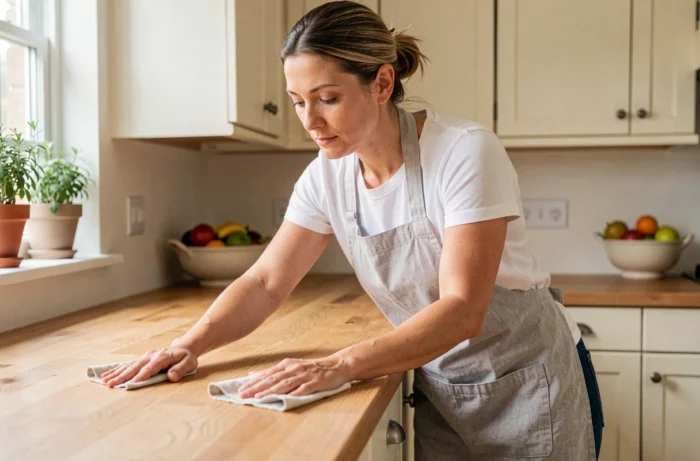
- The kitchen countertop and sink: a quick wipe after each preparation prevents food residues from drying and reduces the need for degreasing products
- The entrance and hallway floor: a vacuum or broom sweep two to three times a week in this area is enough to limit the spread of dust throughout the rest of the home
- The shower or bathtub: wiping the walls after each use halves the time spent on monthly descaling
By concentrating effort on these three points, the rest of the home requires significantly less attention. Less-frequented rooms (guest bedroom, office) can suffice with spaced dusting.
Choosing the right tool according to the flooring
A traditional vacuum cleaner is suitable for carpets and rugs. On tile or varnished wood, a slightly damp microfiber mop is more effective than a broom, as it captures fine dust instead of dispersing it. For oiled wood, water should be used sparingly: a thoroughly wrung mop, never a steam cleaner, to avoid swelling the wood.
Adapting the tool to the floor protects the covering and reduces cleaning frequency.
Storage and decluttering: addressing the cause rather than the symptom
Organizing is pointless if the volume of objects exceeds the storage capacity of the home. Before buying boxes or organizers, the question to ask is straightforward: has this item been used in the last twelve months? If the answer is no, it is a candidate for donation, sale, or recycling.
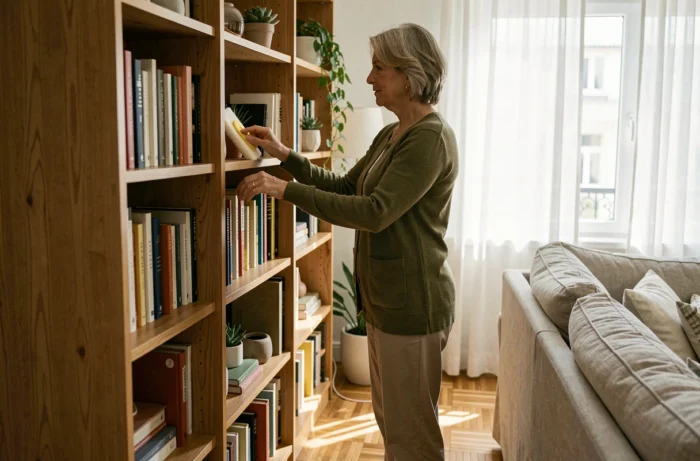
This sorting, done once or twice a year on a single category of items at a time (clothes, books, kitchen utensils), has a measurable effect on cleaning time. Fewer objects on surfaces means less accumulated dust and faster cleaning, without having to move every knickknack.
Daily organization then boils down to a simple gesture: putting each used item back in its place before leaving the room. This reflex of a few seconds, applied systematically, prevents the accumulation effect that transforms an orderly interior into a construction site in just a few days.
Maintaining a home relies more on the regularity of short actions than on the duration of cleaning sessions. Checking air quality before ventilating, reading household product labels, targeting the areas that get dirty the fastest, and reducing the number of objects to maintain: these four levers, combined, significantly change the daily life of a home.