The grelinette holds a special place in ecological gardening. Presented as the ideal alternative to plowing, it aerates the soil without turning it over and preserves the microbial life in the different layers of earth. Field reports show a more nuanced reality: this tool is neither universal nor always necessary, and its effectiveness primarily depends on the condition of the soil on which it is used.
Grelinette and soil biology: what aeration really changes
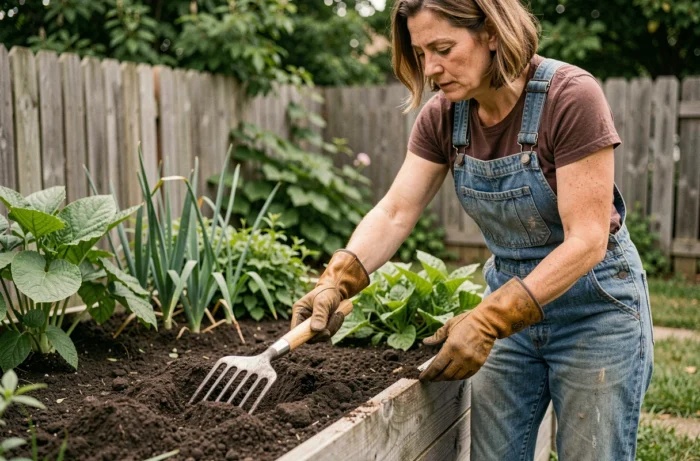
The principle of the grelinette relies on a lever action that lifts the earth without inverting the layers. Aerobic microorganisms remain on the surface, while anaerobic ones stay deep. Traditional plowing, whether with a spade or a tiller, mixes these populations and disrupts their living conditions for several weeks.
This preservation of soil stratification has a direct effect on the transformation of organic matter into humus. Earthworms, mycorrhizal fungi, and nitrifying bacteria continue their work uninterrupted. For a permaculture vegetable garden, where compost and mulching nourish the surface, maintaining the soil life intact remains the primary lever of fertility.
Specialized resources like grelinette-warrior.com detail the different models and their uses according to the nature of the terrain, allowing for the selection of a tool suited to one’s plot rather than blindly opting for a standard model.
Compact soil or living soil: the grelinette is not suitable for all terrains
One of the blind spots in articles about the grelinette concerns its limitations on difficult soils. On very compacted, stony land or land overrun with deep roots, the tool’s tines struggle to penetrate. A fork-spade remains more effective for initial decompaction on this type of terrain.
The grelinette performs best on soil that is already structured and relatively loose. It is a maintenance tool, not a clearing tool. Confusing the two uses leads to straining the handles, bending the tines, and becoming discouraged.
The trap of systematic use
A recommendation published in September 2026 by Jardin & Moi and Jardin Astucieux advises diagnosing compaction before intervening. A permanent bed, properly mulched and never trampled, may not require the use of a grelinette. Aerating soil that is not compacted disrupts an already functional balance.
Before taking out the tool, a simple test involves pushing a finger or a stick into the ground about ten centimeters. If penetration occurs without resistance, the soil breathes sufficiently.
Soil moisture and working window: an underestimated parameter
Working with a grelinette on waterlogged soil produces the opposite effect of what is desired. Wet soil smooths under the pressure of the tines, creating a compaction layer below. The result is soil that is even more impermeable than before the intervention.
Recent recommendations emphasize a specific point: test the moisture in several places on the plot before starting. The soil should lift in crumbly clumps without sticking strongly to the tines. This precaution invalidates fixed schedules like “use the grelinette in March and October,” which do not take real weather conditions into account.
In practice, the right window is a few days after rain, when the soil has had time to dry out. In clay soil, this waiting period can take a week or more.
Grelinette against perennial weeds: the limits of no-till
The grelinette allows for the extraction of certain taproots (dandelion, dock) by lifting the clump without breaking it apart. The action preserves the entire root more than a spade cut that slices it and multiplies regrowth.
However, against rhizomatous plants like couch grass or bindweed, aeration alone is not enough to eliminate the underground network. Recommendations combine the use of a grelinette with targeted manual extraction of the rhizomes, segment by segment. Without this complementary work, the fragments left in the ground quickly regrow.
Combine grelinette and mulching to limit recolonization
After extracting the rhizomes, covering the area with thick mulch (dead leaves, wood chips, hay) deprives weeds of light and slows their return. This grelinette-mulch combination works better than using a tool alone, as it acts on both soil structure and weed pressure.
- Lift the soil with the grelinette to expose the rhizomes without fragmenting them
- Manually extract each visible root segment, following the network along its entire length
- Immediately mulch the worked area with a sufficient thickness to block germination
- Monitor regrowth for several weeks and intervene manually as needed
Choosing a grelinette according to the reality of your garden
The number of tines determines the working width, but also the weight and effort required. A three-tine model is suitable for small areas and heavy soils. Five-tine models cover more ground but require soil that is already loose to be handled without straining.
Several criteria deserve attention before purchase:
- The nature of the soil: clayey, sandy, loamy, stony – each texture imposes a different type of tine and spacing
- The area to be worked: beyond a few dozen square meters, a wider model saves time
- The quality of the steel of the tines: forged tines withstand stony soils better than welded tines
The right tool is the one that corresponds to the existing soil, not the dreamed soil. Buying a five-tine grelinette for a fallow land amounts to investing in a tool that will only be fully utilized in two or three years, once the soil has been improved with compost and mulching.
The grelinette fits into a logic of ecological gardening where each intervention is justified by a real need of the soil. Diagnosing before acting, adapting the tool to the terrain, accepting not to intervene when the soil is already functioning: this approach is what makes a vegetable garden sustainably productive, much more than the choice of a particular tool.