DIY encompasses all practices of making, transforming, or repairing objects done without the help of a professional. In 2026, these practices move away from mere decorative hobbies to become part of daily routines: cooking, garden maintenance, clothing transformation. The Pinterest Hobbies Trend 2026 report structures this evolution around specific categories that redefine what it means to “create oneself.”
Domestic Rituals and New Territories of DIY in 2026
Current creative trends are no longer limited to wall decoration or traditional scrapbooking. The Pinterest 2026 report identifies four axes that reflect a shift towards creative projects related to lifestyles.
- Kitchen Witch: homemade fermentation, preparation of scented candles, apothecary of dried herbs. DIY enters the kitchen as an extension of artisanal food.
- Home Café Engineering: creating personalized coffee corners, making homemade syrups, designing domestic menus. The personalization of the coffee ritual replaces the purchase of standardized capsules.
- Backyard Botanist: illustrated field notebooks, pressed flower herbariums, nature watercolors. The garden becomes an open-air workshop.
- Secondhand Sidequest: transformation of second-hand clothing, visible repair aesthetics. Searches related to “thrift flip” have surged by over 600% according to Pinterest.
These four axes share a common point: each creative project produces a useful object or a repeatable ritual, not just a one-off decorative element. To follow all the news on Les Bricoleries de Nanie, this evolution towards a DIY rooted in daily life constitutes a permanent thread.
Natural Materials and Chenille Wire: Dominant Creative Techniques
Two families of materials are capturing the attention of creators in 2026. On one side, plant-based and recycled materials (linen, jute, raw wood, kraft paper). On the other, accessible supplies like chenille wire, which allows for creating durable floral arrangements without prior skills.
Chenille Wire and Eternal Flowers
Chenille wire (or pipe cleaner) is worked by hand, without special tools. It can be bent, twisted, and cut with scissors. The most common creations are eternal flower bouquets, decorative wreaths, and table accessories.
Chenille wire is appealing because it forgives mistakes: unlike sewing or knitting, it requires no technical progression to achieve a presentable result. It is a relevant entry point for beginners or family workshops.
Wood and Paper in Décor Projects
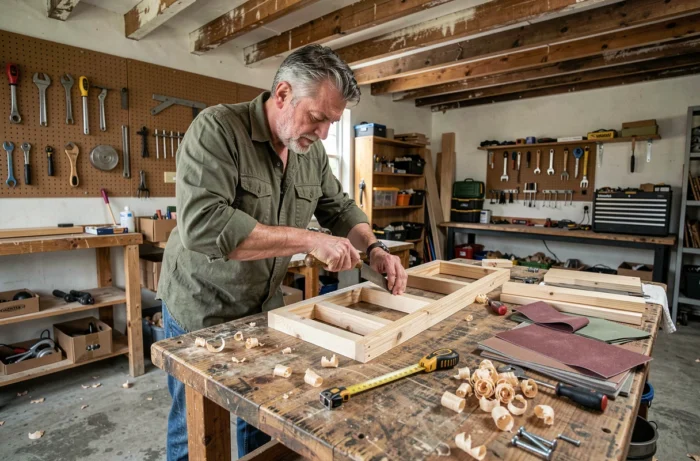
Wood remains a central material in DIY décor tutorials, particularly for hanging shelves, frames, and small storage solutions. Paper, meanwhile, is experiencing a resurgence of interest through creative journaling and scrapbooking. Pinterest searches related to scrapbooking journaling have increased by over 240%.
These two materials require minimal tools (miter saw for wood, paper cutter or rotary cutter for paper) and lend themselves to projects that can be completed in a single session.
Visible Repair and Secondhand: The Anti-Waste DIY
The “Secondhand Sidequest” category identified by Pinterest deserves particular attention because it redefines the very notion of creation. Transforming a thrifted garment does not start from new material, but from an existing object. The creative gesture involves modifying, dyeing, embroidering, or restructuring.
The term repair aesthetic refers to this trend of making repairs visible and accepted. Associated searches have increased by over 167% according to Pinterest. This concretely translates into decorative patches (Japanese sashiko technique), contrasting topstitching on jeans, or added embroidery on holey sweaters.
This approach changes the relationship with the necessary materials. There’s no need to buy complete kits: a needle, brightly colored thread, and a damaged garment are enough. The entry cost is virtually zero, which partly explains the rapid spread of this practice on social media.
Creative Workshop at Home: Organizing Your Space and Tools
A successful DIY project depends as much on the gesture as on the material organization. Three elements structure a functional workshop, even in a small space.
The first is a protected work surface. A self-healing cutting mat (minimum A2 size) protects the table and provides a grid for cutting paper or fabric.
The second is vertical storage. Pegboards allow for hanging scissors, clamps, spools of thread, and rolls of masking tape. An organized wall reduces the time spent searching for tools to just a few seconds.
The third is lighting. An adjustable lamp with neutral light (neither too warm nor too cold) prevents eye strain during detailed work like embroidery or cutting.
These three elements do not require a significant budget. Most can be found at a hardware store or made DIY, which completes the logic of a self-sufficient creative workshop.
DIY Inspirations and Online Sharing: The Role of Video Tutorials
The dissemination of creative trends is heavily reliant on short video content. Tutorials of a few minutes showcase the entire process, from raw materials to the finished object, which removes the main barrier to taking action: knowing what the result will look like before starting.
The most viewed formats include a list of supplies at the beginning of the video, a real-time walkthrough of critical steps, and a final shot of the completed object. This standardized format works equally well for knitting, candle making, or furniture transformation.
DIY in 2026 is not just a collection of decorative ideas. It is based on structured practices (repair, fermentation, journaling) that produce useful objects and daily rituals. The underlying trend remains the same: to make oneself what one will actually use, with accessible materials and learning through video.