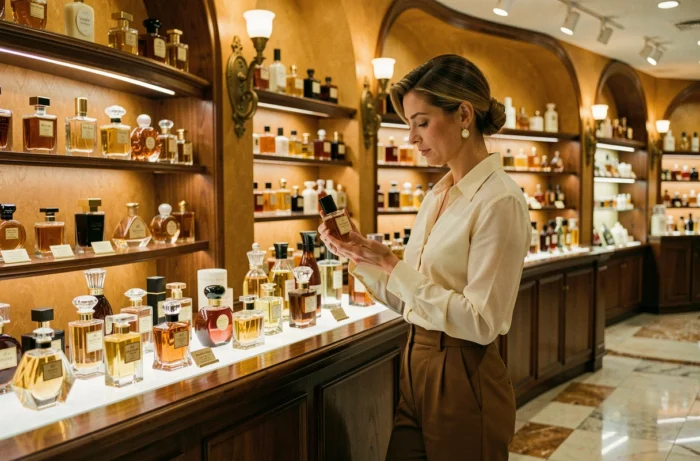
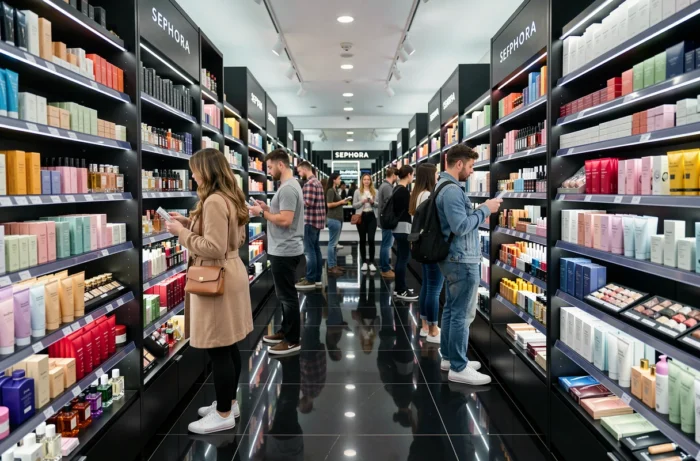
When you push open the door of a Sephora store, you enter a space where products are freely accessible, without closed displays or imposed salespeople. This principle, commonplace today, was a small revolution in the beauty retail sector in France. The brand, present in dozens of countries, originated from a provincial town far from the Champs-Élysées.
The Shop 8 Concept in Limoges: An Idea Born Far from Paris
Before it was called Sephora, the brand went by another name. In 1969, Dominique Mandonnaud launched a store in Limoges called Shop 8. The principle is simple: to offer perfumes and cosmetics in self-service, while the norm in the beauty sector relies on closed counters where a consultant serves each customer.
This choice is not trivial. At the time, touching a bottle of perfume without the help of a salesperson is almost unthinkable in a traditional perfumery. Mandonnaud takes the opposite approach by betting on customer autonomy. The model works locally for a decade before gaining momentum.
To better understand the history and origin of Sephora, it is essential to remember this provincial starting point. It was in 1979 that the first self-service store opened in Paris under this new identity, ten years after the launch of the initial concept.

Sephora and LVMH: The Acquisition That Changes the Brand’s Dimension
The major turning point occurs in 1997. The LVMH group acquires Sephora and integrates the brand into its portfolio of houses. This merger transforms a French perfumery chain into a global player in the beauty product distribution.
The backing from LVMH provides a vast network and considerable financial resources. The opening of the Champs-Élysées store, covering more than 1,500 m², had already made an impression in 1996. With the support of the luxury group, expansion accelerates into the United States starting in 1999, with the launch of the first website across the Atlantic.
Why is LVMH interested in a cosmetics distributor? Because Sephora is not just a simple reseller. The brand selects products, creates its own collections, and controls the customer experience in-store. This positioning between distributor and brand curator gives it a rare strategic value in the sector.
An International Expansion in Stages
After Europe and North America, Sephora establishes itself in the Middle East starting in 2007. The brand also recently opened its first stores in Israel, confirming a strategy of physical presence in diverse markets.
At the same time, the brand develops exclusive selections. The “Only at Sephora” range, launched in the United States and then extended to the European market in 2004, highlights emerging brands available exclusively. This approach strengthens customer loyalty, as they find products in-store that are unavailable elsewhere.
Sephora in China: A Setback That Highlights the Model’s Limits
The story of Sephora is not just a triumphant conquest. The Chinese case illustrates the difficulties the brand faces in complex markets.
Sephora’s joint ventures in China have shifted from profitability to continuous losses starting in 2022. The two local entities (Sephora Shanghai and Sephora Beijing), created in joint venture with Shanghai Jahwa, had generated significant profits between 2019 and 2021. The trend has sharply reversed, with very high cumulative losses between 2022 and 2025.
This turnaround is explained by the rise of local competitors and Chinese online sales platforms, which have captured an increasing share of beauty product consumers. The model of the Western physical store, even in self-service, is no longer sufficient against players who master local digital commerce perfectly.
K-Beauty Corners at Sephora: When the Competitor Becomes a Partner
Have you noticed the rise of Korean cosmetics in beauty aisles? Sephora had to adapt its strategy in response to this trend. Rather than fighting head-on against specialized stores like Olive Young, the brand chose an unexpected approach.
Since August 2026, more than 500 Sephora stores in the United States feature an Olive Young K-Beauty Edit corner. This partnership showcases a selection of 19 Korean brands chosen by Olive Young. Sephora provides the space and retail network, while the Korean partner brings its curation expertise.
In practice, Sephora shifts from the role of international conqueror to that of a welcoming platform for a former rival. The model resembles what some large grocery stores do by hosting corners for specialized brands.
- Sephora retains in-store traffic by offering brands that its customers actively seek
- Olive Young gains access to a massive physical network without investing in its own American stores
- Consumers find Korean skincare in a familiar setting, without having to search for specialized shops
A Signal for the Future of Beauty Distribution
This collaboration reflects a broader transformation in the market. The value of a beauty brand relies less on its walls than on its ability to attract the right brands. Customers want access to trendy products, regardless of who manufactures or selects them.
Sephora has also recently launched a partnership with Rhode, Hailey Bieber’s skincare brand, for its European expansion. These alliances show that the brand is positioning itself as a hub rather than just a cosmetics distributor.
From Shop 8 in Limoges to K-Beauty corners in hundreds of American stores, Sephora’s trajectory reflects the changes in beauty commerce over more than five decades. The brand that popularized self-service in perfumeries must now reinvent its model in the face of digital competitors and increasingly volatile consumers. The partnership with Olive Young, signed in 2026, provides a first concrete indication of the chosen direction.