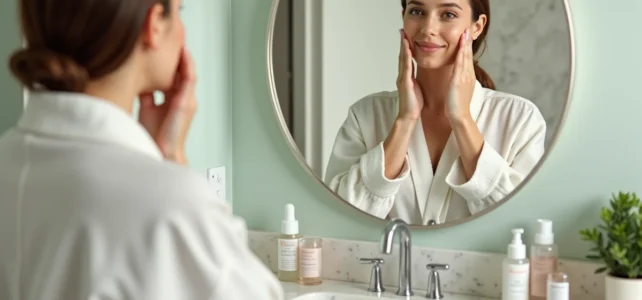
An effective beauty routine is based on a principle that is often overlooked: adapting your actions to the actual state of your skin, not to a universal list of products. The skin evolves according to the season, hydration level, stress, or sleep quality. Enhancing your daily routine starts with understanding what is happening on the skin’s surface before choosing a treatment, action, or texture.
Skinimalism and beauty routine: why reducing steps works
In recent years, the trend of skinimalism has redefined skincare protocols. The principle is simple: abandon routines with eight or ten steps to focus on three or four targeted products. This movement is not just a fad. It responds to a dermatological observation: layering too many active formulas weakens the skin barrier instead of strengthening it.
A gentle cleanser, a moisturizer suited to your skin type, and sun protection in the morning. For many skin profiles, these three actions cover most needs. The idea is not to eliminate all cosmetic pleasure, but to prioritize: a serum or a gentle chemical exfoliant can be added occasionally, depending on the signals the skin sends (tightness, shine, roughness).
Several brands are restructuring their ranges around these core products rather than offering complex protocols. To explore selections designed with this logic, the Autour de Chloé beauty site gathers references that facilitate this sorting between the superfluous and the necessary.

Adapting your facial routine to the seasons and temperatures
A treatment that works in January may become unsuitable in July. The recurring heat waves in Europe have led to specific recommendations for managing the skin during periods of high heat, a topic rarely linked to daily routines in general content.
Morning routine in hot weather
When the temperature rises, the skin produces more sebum. Ultra-fluid textures replace rich creams without compromising hydration. A minimal rinse in the morning (micellar water or simply rinsing with lukewarm water) is often sufficient, provided you have thoroughly cleansed the night before.
Sun protection remains the most cost-effective gesture in any beauty routine, regardless of the season. Anti-shine formulas with mattifying properties allow for the combination of SPF and comfort on combination to oily skin.
Evening routine and double cleansing
In the evening, double cleansing makes perfect sense when wearing makeup or a waterproof sunscreen. An oily product (oil, balm) dissolves UV filters and pigments, followed by a water-based cleanser to remove residues. This two-step action prevents the accumulation of impurities that dull the complexion over time.
In winter or dry weather, the logic reverses: we lighten the cleansing and enhance hydration with denser textures, rich night creams containing occlusive agents that limit water loss during sleep.
At-home beauty tech: what devices change in the routine
The rapid spread of at-home skincare devices in recent years is changing how we structure a weekly routine. LED light therapy, microcurrents, thermal or cryo devices: these tools do not replace cosmetics, but they act on parameters that creams alone cannot reach.
- Red LED light therapy stimulates collagen production and promotes skin recovery. One to three sessions per week are sufficient to observe an increase in firmness over several weeks.
- Microcurrent devices tone facial muscles, contributing to a gradual lifting effect without injections.
- Cryo devices (localized cold) reduce puffiness and temporarily tighten pores, a useful complement in the morning before makeup.
A common mistake is to multiply devices without coherence. As with cosmetics, one well-used tool is better than three poorly integrated ones. The protocol benefits from being planned over the week: LED on Monday and Thursday, microcurrents on Wednesday, resting on other days to allow the skin to recover.

Hydration, sleep, and complexion glow: often underestimated levers
No serum can compensate for chronic dehydration. The water you drink directly influences the skin’s suppleness and glow. This is not cosmetic advice; it is a physiological fact: dehydrated skin loses elasticity, marks more easily, and heals less effectively.
Sleep plays a comparable role. During the night, the skin accelerates its cell renewal and collagen production. Poor quality sleep reduces these mechanisms, resulting in a dull complexion and pronounced dark circles that even a good eye cream struggles to conceal.
- Drink regularly throughout the day rather than large amounts at once.
- Apply your night treatment (cream or oil) just after cleansing, on slightly damp skin, to maximize absorption.
- Sleeping on a smooth pillowcase (silk or satin) reduces friction and limits the formation of pillow creases that can eventually mark the skin.
The glow of the complexion is built as much at night as in the morning. Investing in the quality of your sleep and maintaining regular hydration produces visible results in a few weeks, often clearer than adding yet another product to your bathroom.
The most effective beauty routine is the one you maintain over time. Three consistent actions are worth more than ten actions abandoned after two weeks. The final selection criterion is not the promise on the packaging, but the regularity with which you apply what truly suits your skin.