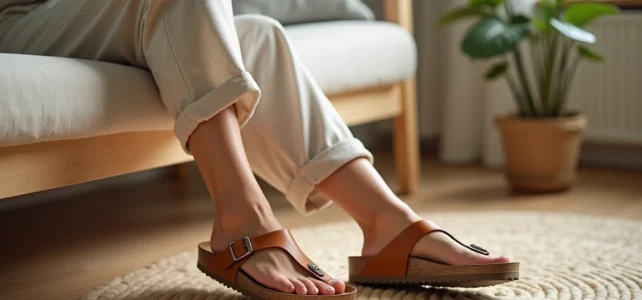
We’ve been standing since six o’clock, in sandals, at a market in full sun. After twenty minutes, some pairs make you forget you’re wearing them. Others remind you of their presence with every step. Between Scholl and Birkenstock, the choice isn’t about the brand, but about what you concretely expect from your shoes from day one.
Adaptation period: the criterion no one tests in-store
A Scholl generally provides noticeable comfort right from the fitting. The synthetic or foam sole adapts quickly, without any significant break-in period. You slip on the pair, walk, and your foot is secure.
With a Birkenstock Arizona, it’s a different story. The cork-latex sole requires one to three weeks of adaptation to mold to the arch of the foot. In the first few days, the contours underfoot can be surprising, even uncomfortable. After this break-in, the sole conforms to the exact shape of the foot and offers very personalized support.
This time difference changes everything depending on the use. For a vacation starting tomorrow, a comfortable pair right out of the box has an obvious advantage. For daily wear over several months, the investment in patience with the Birkenstock cork pays off significantly. Before buying, you can compare Scholl and Birkenstock shoes based on specific criteria like sole stiffness or the type of arch targeted.

Scholl sole vs. Birkenstock sole: stiffness and arch support
The fundamental difference lies in the construction of the insole. Birkenstock uses a combination of natural cork and latex, molded to replicate the anatomical shape of the foot. There is a pronounced hollow under the arch, a rim that contains the heel, and a slight elevation at the front to engage the toes while walking.
Scholl offers softer insoles, often made from synthetic materials or memory foam. The support is less rigid, more enveloping. The Scholl support targets immediate comfort rather than postural correction.
What it means for sensitive feet
Feedback varies on this point, but a trend emerges. For people prone to plantar fasciitis or heel spurs, the rigidity of the Birkenstock sole often provides better long-term arch support. Cork does not compress as quickly as synthetic foam.
For wide feet, Birkenstock offers two widths on most of its models (regular and narrow). Scholl generally sticks to a standard fit. If you have wide feet and are looking for an open sandal, the double width Birkenstock avoids lateral compression.
Materials and durability: leather, cork, and synthetic put to the test
The materials dictate longevity and feel when worn. Here’s what you find on the common models of both brands:
- Birkenstock favors leather (smooth, nubuck, or suede) for the straps and natural cork for the sole. The EVA outsole holds up well to wear. Cork is difficult to resole but lasts several seasons if you avoid standing water.
- Scholl uses more synthetic materials, faux leather, and technical textiles. High-end models incorporate genuine leather, but the majority of the range remains on mixed compositions. The price reflects this: Scholl positions itself at a more accessible price point for its entry-level models.
- Weight differs significantly. A Birkenstock Arizona weighs more than an equivalent Scholl sandal, due to the cork-latex block. Over long distances, some find this weight reassuring, while others consider it tiring.
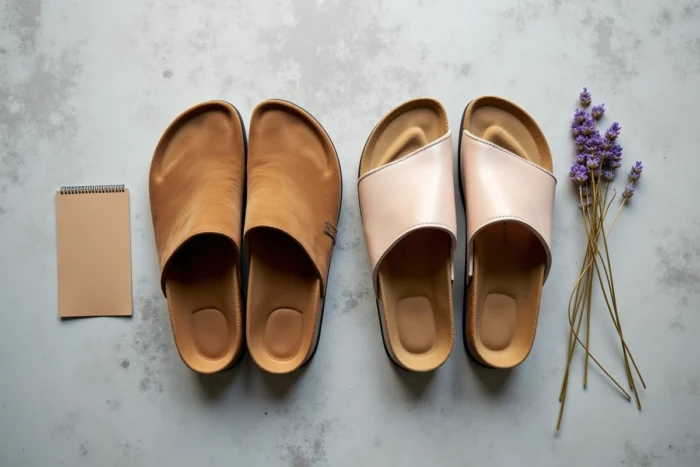
Choosing between Scholl and Birkenstock based on daily use
The right choice depends less on the brand than on three concrete questions: how long you stand, what type of surface you’re on, and how frequently you wear the pair.
Office or indoor use
For sedentary wear (office, home), Scholl offers appreciable plug-and-play comfort. Mule or clog-type models slip on easily, and the sole cushions well on hard floors. No break-in needed, no width constraints.
Extended walking or standing
For days of walking (tourism, standing jobs), Birkenstock takes the advantage once the adaptation period is over. The cork arch support reduces foot fatigue over long distances. The Arizona model remains the reference for this use, but the Boston (closed model) is better suited for mid-seasons.
Style and versatility
Birkenstock has gained fashion visibility in recent years, with collaborations and a strong presence in streetwear. Scholl maintains a more functional image, focused on well-being. Both brands offer sandals, mules, and clogs, but their aesthetic codes do not really intersect.
- For a relaxed, casual look: Birkenstock Arizona or Madrid
- For discreet health-comfort use: Scholl, professional range or models with thin straps
- To alternate between city and beach: Birkenstock EVA (fully plastic model, washable, lightweight)
The comfort of a shoe is not limited to the sole. The width of the foot, the sensitivity of the arch, and the time you are willing to invest in breaking them in weigh as heavily as the price or style. Scholl is suitable when you want comfort without waiting, Birkenstock when you’re betting on the long term. Both have their merits, but not for the same feet or the same days.