
A hedge trimmer is a cutting tool equipped with two toothed blades that slide in an alternating motion. The quality of the result depends on three mechanical parameters: the cutting speed, the spacing of the teeth, and the blade length. Understanding these parameters before looking at brands or prices helps avoid most purchasing mistakes.
Cutting speed and tooth spacing: the two criteria that guides overlook
The cutting speed refers to the number of alternating movements of the blades per minute. To achieve a clean cut, especially on wet or semi-woody branches, you should aim for a minimum of 4,000 strokes per minute. Below this, branches tend to be torn rather than cut, which weakens the hedge and leaves wounds prone to diseases.
The spacing of the teeth determines the maximum diameter of branches that the tool can accept. For a regularly maintained hedge, a spacing of 28 to 35 mm is sufficient. If the hedge has been neglected for several seasons and has woody branches, a spacing of 38 to 45 mm becomes necessary to avoid straining the mechanics.
These two data points are rarely found on consumer packaging. They can be found in the manufacturer’s detailed technical sheet. Comparing them between two models on taille-haie-warrior.com allows for quick filtering of devices suitable for the actual thickness of the vegetation to be cut.
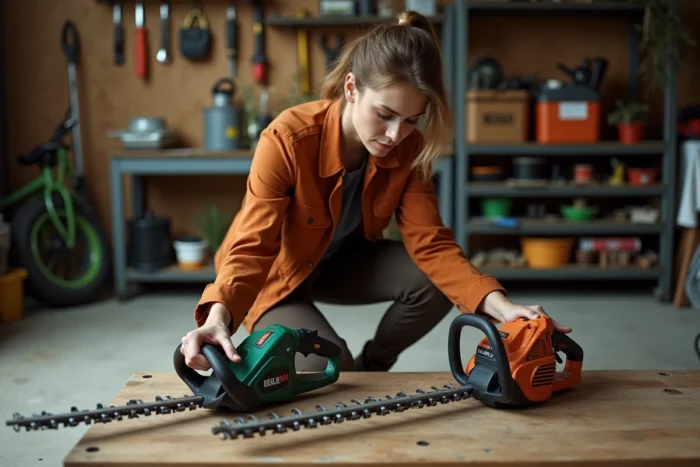
Hedge trimmer motorization: battery, electric corded, or gas
The choice of motorization affects autonomy, weight, and noise level. There is no universally superior motorization: each meets a specific use.
Battery hedge trimmer
36 V platforms and above now offer power comparable to many entry-level gas models. A 36 V battery hedge trimmer covers the majority of residential hedges without the constraints of fuel or engine maintenance (oil changes, air filters, spark plugs).
The weight of the battery adds a few hundred grams. During a prolonged trimming session, this matters. Choosing a model whose battery is compatible with other tools of the same brand reduces the overall cost of the equipment.
Corded electric hedge trimmer
This is the lightest and cheapest format to purchase. The power is constant as long as the cable is plugged in, with no drop in performance at the end of the charge. The limitation is obvious: the range depends on the length of the extension cord, and the cable hinders progress along winding hedges.
Gas hedge trimmer
The two-stroke engine provides the highest power. This type is suitable for very long lines or thick hedges made of hardwood species. In return, the noise level far exceeds that of electric models. In dense housing areas, battery tools are increasingly recommended by municipalities to limit noise pollution and local pollution.
Blade length and weight: adapting the tool to the hedge
The blade length should be chosen based on the width of the hedge, not its height. A blade should be able to pass through the thickness of the foliage in a single pass. If the hedge is less than 50 cm deep, a short blade offers more maneuverability. For a wide hedge or a dense curtain of thuja, a longer blade reduces the number of passes and speeds up the work.
The total weight (tool plus battery, if applicable) directly influences muscle fatigue. A tool that is too heavy for the user leads to imprecise movements and increases the risk of accidents. Before purchasing, holding the device with arms extended for about thirty seconds gives a realistic idea of comfort in real conditions.
- Maintained hedge, moderate thickness: short to medium blade, spacing 28-35 mm, lightweight battery or corded model.
- Neglected hedge or hardwood: long blade, spacing 38-45 mm, gas or battery 36 V and above.
- Tall hedge requiring work at height: pole hedge trimmer, regardless of the type of motorization.
Warranty and availability of parts: a long-term criterion
A well-chosen hedge trimmer lasts several seasons. For this, a minimum three-year warranty and the quick availability of wear parts (replacement blades, filters, guards) are determining criteria. A device whose blades are no longer manufactured two years after purchase becomes premature waste.
Checking that the manufacturer has a network of authorized repairers, or at least a customer service capable of shipping parts within a few days, is part of the analysis before purchase. This point often distinguishes two models with similar technical sheets.
Maintenance of hedge trimmer blades: protecting the investment
After each use, cleaning the blades with a cloth to remove sap and plant residues prevents oxidation. Applying a lubricant to the blades after cleaning reduces friction and extends their lifespan.
Sharpening the blades once or twice per season maintains cutting quality. Dull blades crush stems instead of cutting them, which slows down the healing of the plant and encourages the growth of fungi.
The choice of a hedge trimmer is based on measurable technical parameters, not just on price alone. A device whose cutting speed, tooth spacing, and blade length match the actual hedge in the garden will yield a clean result with less effort, season after season.