
The choice of a hedge trimmer depends on three technical parameters that most guides overlook: the spacing of the teeth, the actual cutting speed under load, and the low-speed motor torque. We will detail these points, then address the regulatory and financial framework that currently guides the choice between gas and battery.
Tooth Spacing and Actual Cutting Diameter of the Hedge Trimmer
The tooth spacing determines the maximum branch diameter that the blade can grasp. A standard spacing is suitable for privet or laurel hedges where the branches remain thin. For hornbeam, beech, or mature photinia, a wider spacing is necessary to avoid clogging and premature wear of the blades.
The professional rule known as the three-diameter rule simplifies the distribution of work: the pruner handles the thinnest branches, the lopper deals with the intermediate diameter, and the hedge trimmer takes care of the regular foliage and branches corresponding to its spacing. Applying this logic avoids forcing the blade and preserves the cutting mechanism.
We recommend checking the actual spacing on the manufacturer’s technical data sheet rather than relying on the marketing mention “cuts up to X mm,” which often corresponds to a laboratory test on soft, dry wood.
To compare the technical data sheets of many battery and gas models, the references available on taille-haie-warrior.com allow for a quick cross-reference of spacing, blade length, and voltage.
Blade Length and Cutting Ergonomics
A long blade covers more surface area per pass but adds weight to the tool and reduces maneuverability in vertical cutting. For tall hedges requiring work at arm’s length, a short blade with a manageable weight will be less tiring on the shoulders and wrists.
The ideal blade length depends on the width of the hedge, not its height. A narrow hedge is perfectly trimmed with a compact blade. In contrast, a thick hedge over half a meter requires a blade that exceeds the depth of the foliage to achieve a consistent cut in one pass.
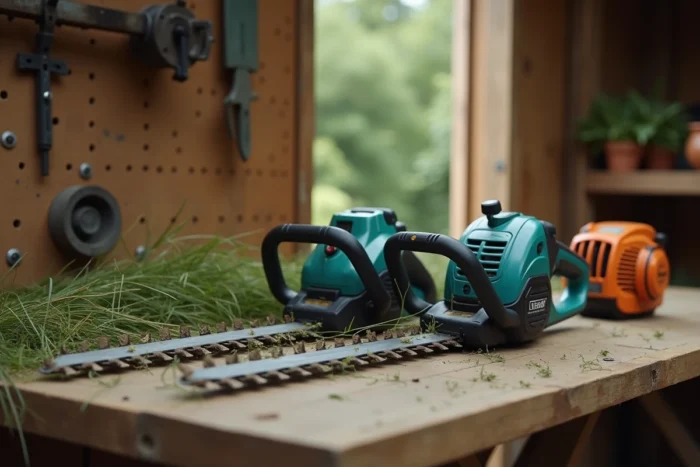
Gas or Battery Hedge Trimmer: The Real Technical Trade-off
The gas trimmer has a clear advantage in one area: sustained motor torque during long sessions without power loss. On a hedge several dozen meters long with woody branches, a battery model experiences a drop in voltage at the end of the charge, which slows the cutting pace and increases the risk of clogging.
The battery, on the other hand, is quickly advancing in autonomy and power. Recent manufacturer platforms allow for battery sharing between hedge trimmers, chainsaws, and blowers, which reduces the overall equipment cost. Instant starting, the absence of fuel mixing, and lower noise levels also weigh in favor of use in residential areas.
Bonus Sustainable Gardening and Purchase Aids
Since 2026, the national program Bonus Sustainable Gardening managed by ADEME finances up to 25% of the purchase price of a new electric or manual gardening tool labeled EU, up to a limit of 300 euros per household per year. The condition: not to own equivalent gas equipment.
Local aids complement this bonus for low-income households or those located in densely populated urban areas, with a rate that can reach 40% and a higher ceiling. The impact on choice is direct: a battery hedge trimmer can end up being cheaper than a gas one after subsidy.
- Check eligibility for the Bonus Sustainable Gardening before purchase, as reimbursement is conditioned on the absence of equivalent gas tools in the household.
- Keep the invoice and the EU labeling certificate of the product to compile the ADEME file.
- Consult the town hall or intercommunal authority to identify local supplements, which vary by territory.
Hedge Trimming Period: A Constraint That Influences Tool Choice
Agricultural operators benefiting from the CAP are subject to the BCAE 8 biodiversity standard, which prohibits the trimming of hedges and trees from March 16 to August 15 on declared plots. Even a simple tidy-up with a hedge trimmer is affected.
For individuals, there is no strict national prohibition, but many municipalities adopt local decrees limiting trimming during the nesting period. Some subdivision regulations also impose time slots for the use of motorized tools.
This concentration of trimming into two short windows (late winter and late summer) has a technical consequence: the tool must manage denser vegetation than with maintenance spread out. The chosen hedge trimmer must therefore have sufficient torque and an appropriate tooth spacing for branches that have had time to develop over several months.

Blade Maintenance and Hedge Trimmer Lifespan
Regular sharpening of the blades is the first factor in longevity. Dull blades strain the motor, increase consumption (or battery discharge), and produce crushed cuts that weaken the hedge against diseases.
- Clean the blades after each use with a cloth soaked in resinous product to remove sap, which accelerates corrosion.
- Sharpen with a fine flat file while respecting the original angle of the teeth, usually visible to the naked eye on the new blade.
- Lubricate the blade with suitable oil before and after each session to limit heating from friction.
On a battery model, we observe that the lifespan of the battery pack strongly depends on the charge cycles. Avoid storing the battery completely discharged or fully charged for several weeks to extend its useful capacity in the long term.
The choice of the best hedge trimmer relies less on the brand or advertised power than on the suitability between tooth spacing, the type of hedge to maintain, and local calendar constraints. With the Bonus Sustainable Gardening, the financial trade-off now clearly leans towards battery for the majority of residential gardens.