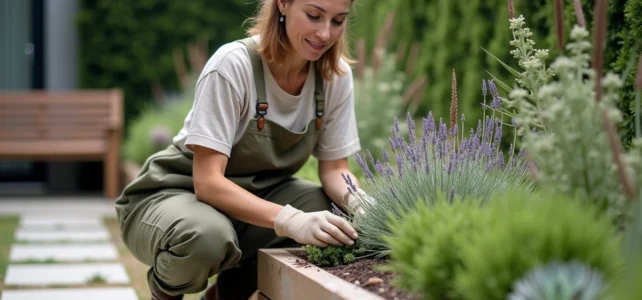
Designing a garden in 2026 is no longer just about placing furniture on a terrace and mowing a lawn. Practices are evolving towards outdoor spaces conceived as self-sustaining ecosystems, where the choice of plants, materials, and soil structure takes precedence over pure decoration. Several underlying trends are reshaping the way we design a landscaped space this year, from the ground up to the canopy.
Alternative Lawns and Living Soil: The End of Traditional Grass
Short, uniform, water-hungry grass is explicitly labeled as an outdated trend in 2026 by several specialized media. The shift towards resilient lawns made of white clover and mixed grasses represents the most significant change for a garden this year.
The principle is simple: replace a fragile monoculture with a mix of ground covers (clover, wildflowers, fine fescues) that requires less mowing, virtually no summer watering, and nourishes pollinators. The soil remains alive, aerated by diverse roots, instead of being compacted under a uniform carpet.
To keep up with the latest news on ambiance-jardin.eu, you can identify varieties suited to each regional climate and the seed mixes available this season.
In practical terms, transitioning from traditional grass to an alternative lawn means accepting a less “clean” appearance in the traditional sense. Vegetation heights vary, flowers appear among the grasses, and mowing shifts from once a week to two or three times a month. It’s a change in perspective as much as in practice.
Matrix Planting: A Landscaping Technique for a Self-Sustaining Garden
Matrix planting is spreading this year well beyond exhibition gardens. This technique involves densely planting perennials and grasses in a mixed manner, without separate beds or sharp borders, to create a plant community that regulates itself.
The functioning relies on complementarity: grasses structure the plant mass and protect the soil, while perennials (echinacea, yarrow, sage) ensure successive blooms. The plants occupy every layer of the soil, limiting the space available for weeds.
Differences from a Traditional Bed
A traditional bed separates species by zones: a row of lavenders here, a group of hydrangeas there. Matrix planting eliminates this block logic. Species are distributed semi-randomly, like in a natural meadow.
- Maintenance is limited to an annual cut at the end of winter, with no regular weeding or summer watering once the plants are established
- Biodiversity naturally increases, as insects find varied resources in a small area
- The appearance evolves with the seasons without intervention, each period offering a different color palette
This approach is particularly suited to medium-sized landscaped gardens where maintenance time is a real constraint.
Snack Garden and Compact Vegetable Garden: Producing Without Exhaustion
The large row vegetable garden, with its complex rotations and hours of weeding, is giving way to the concept of snack garden. The idea: to cultivate on a small surface (one or two square meters is sufficient) edible plants that can be harvested on the go, such as herbs, cherry tomatoes, strawberries, or small peppers.
The snack garden is placed near the kitchen or terrace, not at the back of the yard. It integrates into raised beds, rustic wooden planters, or even grouped terracotta pots. The goal is not self-sufficiency but the pleasure of picking a few fresh ingredients daily.
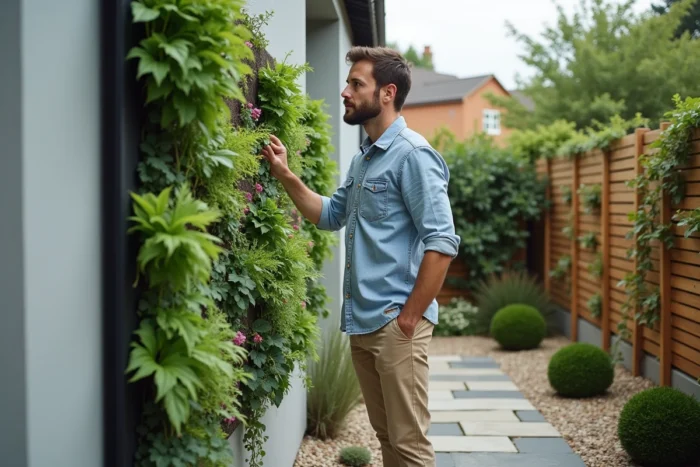
This compact format is also appealing in urban courtyards or on balconies. A 60-centimeter deep container with good substrate can already grow basil, chives, arugula, and a few tomato plants. The key remains the substrate: a rich soil-compost mix to compensate for the limited volume of the container.
Raw Materials and Modular Furniture for Outdoor Spaces
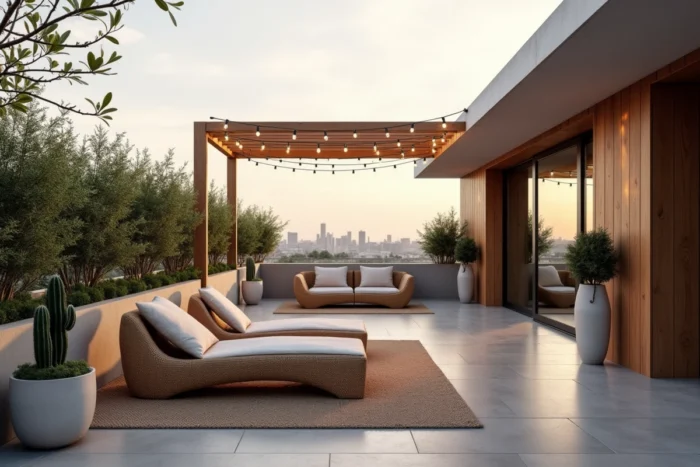
On the hard landscaping side, unprocessed natural materials dominate: local stone, untreated raw wood, weathered corten steel. Smooth concrete paving or synthetic resins are declining in favor of permeable surfaces (stabilized gravel, spaced stepping stones in the alternative lawn) that allow water to infiltrate.
Garden furniture follows the same logic. Fixed sets made of woven resin are being replaced by movable modules, often inspired by hotel terrace furniture. A storage bench, a convertible coffee table, stackable seating: modularity allows adapting the outdoor space to each use, whether for family meals or solitary reading.
Choice of Wood Species
Black locust (false acacia) and untreated Douglas fir naturally resist moisture without chemicals. They gray over time, which aligns with the sought-after raw aesthetic. Teak and ipe, very durable but imported from afar, are losing ground to these local species.
- Black locust offers durability comparable to oak for structures (pergolas, raised beds)
- Douglas fir is suitable for decking and cladding, with a favorable quality-price ratio
- Chestnut, naturally rot-resistant, remains a classic for fences and stakes
The Japanese style also strongly influences landscaping this year, with clean mineral compositions combining raked gravel, laid stones, and a few structural plants like maples or Miscanthus grasses.
Garden design in 2026 is characterized by a clear decline in high-maintenance and high-water consumption solutions. The garden that requires the least maintenance is also the one that functions best ecologically. Whether the available space is a city terrace or a plot of several hundred square meters, the same principles apply: diversify plants, let the soil breathe, and choose materials that age without intervention.